



Upper-Intermediate
What Did Charles Dickens Write?
Who created Oliver Twist and Ebeneezer Scrooge?

You probably already know some of his characters. The hungry Oliver Twist, who dared to ask for more. Miserly old Ebeneezer Scrooge who was haunted by ghosts in A Christmas Carol.
His memorable characters are why Dickens remains one of Britain’s greatest writers. His novels have been noted for their mix of comedy and realism, as well as the way they tackled issues of social inequality in Victorian Britain.
Charles Dickens was born in Portsmouth in 1812. He grew up in London. He came from a poor family. His father was sent to a prison for people who owed money. Young Charles was sent to work in a factory. This experience had a major effect on him. It exposed him first hand to the effects of poverty.
Later, when his father was released, Dickens returned to school. At 15, he found work as an office boy at an attorney’s. In 1829, Dickens became a freelance reporter at Doctor’s Commons Court. A successful reporter of Parliamentary debates in the House of Commons, he took on the pseudonym Boz in 1834. He wrote about London places and people.
Dickens wrote some short texts to accompany a series of humorous sporting illustrations. These later became The Pickwick Papers and were released as a story in monthly parts. It was a major success. Many of the author’s later stories were written in monthly or weekly instalments in journals.
The publication of the first part of his second novel, Oliver Twist (*), began in 1837. The story was told in parts. The last part of the serialisation was published in 1839. Oliver Twist told the story of an orphan who travels to London and meets a gang of young pickpockets. He followed this with many more novels, including The Life and Adventures of Nicholas Nickelby, The Old Curiosity Shop, A Christmas Carol, David Copperfield (*), Bleak House, Hard Times and Great Expectations (*).
In 1856, Dickens bought Gad’s Hill Place. He had walked past this large country house as a child and dreamt of living there. Charles Dickens had a stroke at the age of 58 on June 9, 1870. He died at Gad’s Hill Place, his country home in Kent, England.
WORDS & EXPRESSIONS
miserly, adjective, not generous, doesn’t like spending money
memorable, adjective, very good and worth remembering
tackle, verb, to try to deal with a difficult problem
inequality, noun [U], an unfair situation in which some people have more money or opportunities than others
first hand, adjective, from the original source or experience
poverty, noun [U], the situation or experience of being poor
freelance, adjective, working independently for different companies and not just one company
pseudonym, noun [C], an invented name that a writer uses instead of their real name
humorous, adjective, funny
instalment, noun [C], one of the parts of a story that appears as a series
orphan, noun [C], a child whose parents are both dead
pickpocket, noun [C], someone who steals things from people’s pockets
stroke, noun [C], a condition where somebody’s artery in their brain bursts, so that they may die or become unable to use some muscles

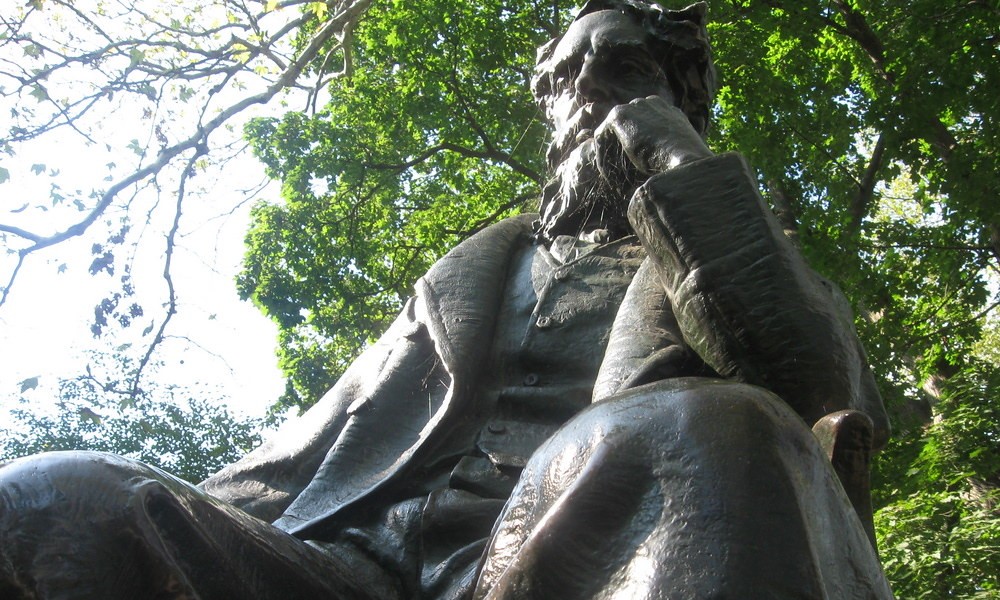
Picture: Kim Woodbridge via Flickr, CC-BY-SA 2.0